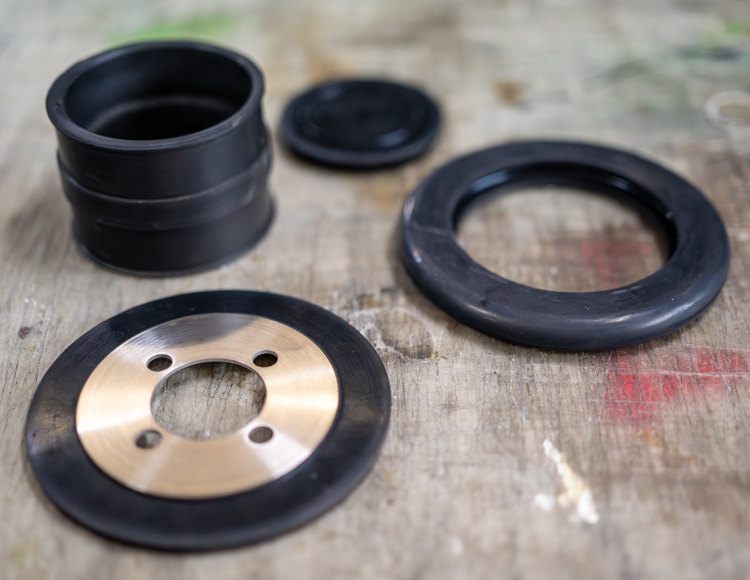
Compare custom rubber moulding Australia-wide with cut seals. See which drawings, quantities and operating details to send South Eastern Gaskets.
Custom rubber components may be cut from sheet material or produced using a purpose-built mould, depending on the application. South Eastern Gaskets assesses the part geometry, material, production volume and service conditions before recommending the most suitable process.
Which Process Suits Your Rubber Component?
A cut seal is generally suitable when the component has a flat profile, uniform thickness and straightforward openings or internal cut-outs. CNC cutting can follow an approved drawing or PDF without requiring a dedicated cutting die, helping reduce initial setup requirements and accommodate design changes.
Compression moulding is more suitable when the component needs varying thicknesses, raised sealing features, curves or another purpose-formed profile. Geometry, material, tolerances and service conditions matter alongside quantity.
CNC-Cut Seals for Flat Profiles
Buyers assessing custom rubber moulding Australia-wide should compare tooling needs with our CNC cutting and compression moulding capabilities. Cutting can suit flat prototypes, replacement seals and recurring orders where sheet material meets the specification.
- Flat component design: Cutting suits gaskets, washers and seals with a consistent thickness and predominantly two-dimensional shape.
- Lower initial setup: CNC equipment can manufacture difficult profiles from a digital drawing without requiring a dedicated mould.
- Design flexibility: The cutting file can be revised if dimensions change during testing or equipment modification.
- Short replacement runs: Maintenance teams can order smaller quantities without spreading mould tooling costs across only a few parts.
- Additional machined features: CNC milling and routing can add steps, pockets and chamfers to some thicker rubber components.
Confirm sheet thickness, hardness and resistance to operating conditions. Allow for rubber flexibility and sheet variation when specifying tolerances.
Custom Rubber Moulding Australia: When Is It Appropriate?
Compression moulding suits formed parts that cannot achieve the required shape or function when cut from flat sheet.
- Three-dimensional geometry: Moulding can produce sleeves, flexible joints, sealing lips, grooves and components with changing thicknesses.
- Integrated construction: Rubber can be vulcanised to metal or vulcanised to another rubber section where the application requires it.
- Repeat production: A completed mould can support future batches within agreed tolerances. ISO 3302-2:2022 on rubber geometrical tolerances covers moulded and extruded solid rubber products, including those with metal inserts. Agree critical tolerances before manufacture.
- Material selection: We mould EPDM, silicone and nitrile. Specify the fluid, temperature and exposure conditions so the compound can be assessed, rather than choosing on the polymer name alone.
- Purpose-built tooling: We have an in-house tool room for producing moulding tools, helping manage manufacturing cost, lead time and quality.
Buyers should provide a dimensioned drawing or usable sample, required quantity, operating temperature, chemical exposure and critical tolerances. A worn sample should be assessed carefully because compression, swelling or damage may have changed its original dimensions.
Match Your Rubber Component with the Right Process
We operate manufacturing facilities in Braeside, Victoria and Lonsdale, South Australia, and serve customers throughout Australia. Our two compression moulding presses support formed rubber products and rubber-to-metal or rubber-to-rubber vulcanising, subject to the component requirements.
For custom rubber moulding Australia-wide, send us your drawing or sample details with quantity, operating conditions and critical dimensions. We can discuss the manufacturing route appropriate to your component.